
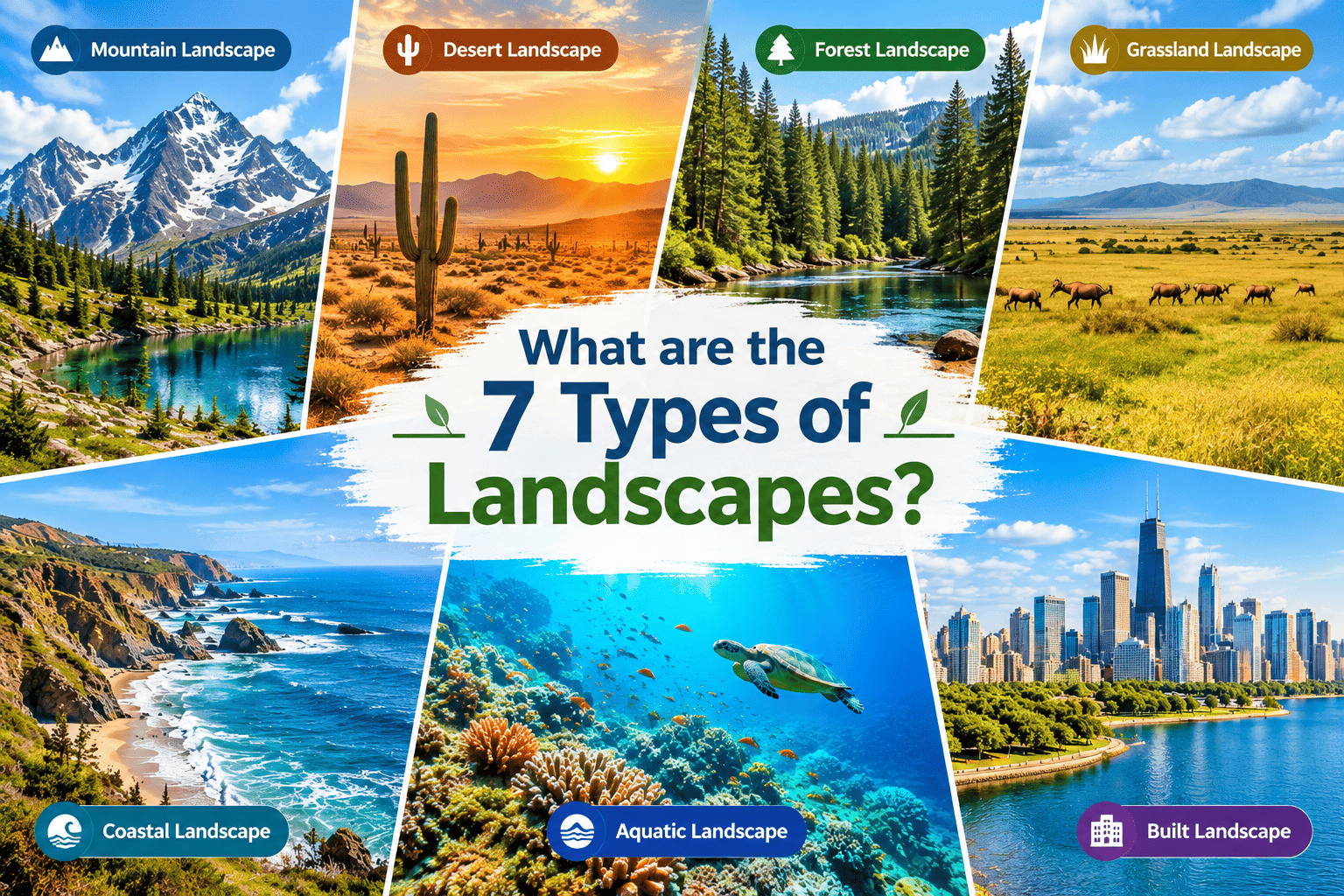
The Earth’s surface has 7 types of landscape classifications: mountain, desert, coastal, forest, grassland, aquatic, and human-made (built), each with its distinct geological formations, climate profiles, biomes, and features.
To appropriately classify and evaluate the environments of the Earth, core landforms (elevation and gradient), regional climates and soils, flora and fauna adaptations, water presence, and levels of human alteration or engineered structures are crucial to consider.
Comprehending the main types of landscapes enables urban planners, environmental scientists of the environment, landscape architects, and land developers to design outdoor spaces that conserve the landscape and use it sustainably without the risk of erosion or other irreversible damage.
The Nature of Terrestrial Landscapes: 7 types of landscape
A terrestrial landscape, primary natural landscape type formed over eons from the weathering forces of rain and wind, the geologic movements, and tectonics of the Earth.
1. Mountain landscape
A mountain landscape consists of rugged elevated landforms created from colliding tectonic plates or volcanism.
Features: The landscape in mountain ranges consists of deep slopes with steep gradients, tall peaks, high ridges, and valleys.
Climate: Different altitude zones are found in mountain ranges, and in many mountain ranges, flora consists of tundra and then alpine forests as we decline in altitude.
2. Desert landscape
Over a fifth of the Earth’s surface is desert, defined by its precipitation rather than by heat.
Climate: Desert landscapes range from hot sandy dunes that inhabit portions of Northern Africa and Western Asia to the cold gravel plains of the Gobi Desert, which is primarily in Asia. All deserts have an average annual precipitation of under ten inches.
Flora and Fauna: Cacti and succulents are common plants in the arid desert climate, while most desert animal life either is active during cooler nights or conserves water while burrowing underground to keep a stable body temperature.
3. Forest landscape
The forest landscape is nature’s absorber of carbon dioxide, while supporting over eighty percent of its terrestrial animal species.
Forest types: They range from the warm tropical rainforest to the colder temperate deciduous and boreal (Taiga) forests of the north.
Habitats for the planet’s species: The diversity in forest environments provides a stable living area for animal and plant life and helps stabilize the planet’s climate and atmosphere.
4. Grassland landscape
Grassland landscape consists of a region with no major tree development and a grassland or herbaceous ecosystem with shrubs or trees but without major forest coverage. It usually exists between forest and desert landforms.
Climates of Grasslands: Tropical grasslands typically have seasons of dry and wet periods known as savannas, while grasslands in higher altitudes with hot dry summers and cold winters are known as steppes.
Ecological Role: Grasslands have deep-rooted plants to protect against soil erosion and are excellent habitats for grazing herd animals that roam the landscape.
Coastal, Water and Built Landforms
The influence of water and human activity on land creates additional classifications for this landscape.
5. Coastal landscape
Coastal landforms are developed where the open sea meets a landmass and thus are an environment under constant flux.
Geological features: These range from rock formations, like cliffs and sea caves, to sandy beaches with dunes. Tides cause the changing coastal landscape to create large beaches, rock fields, and tidal marsh areas.
Dynamic environment: The landscape of coasts is greatly affected by the action of waves and tides, so flora must be exceptionally adaptive.
6. Water landscape
An aquatic landscape is where water defines a dominant section of the Earth’s surface. Water landforms can be split between fresh and salt water.
Freshwater landforms: These include flowing rivers and streams and static ponds and lakes, along with wetlands that act as biological filters for the terrestrial land.
Saltwater landforms: This refers to bays, tidal areas, oceans, and estuaries. Oceans also provide control over the planet’s climate and are habitats for countless marine creatures and habitats such as coral reefs.
7. Human-made (built) landscape
Unlike the other six landforms, the human-made (built) landscape is the result of human architectural and engineering actions modifying and controlling nature.
Human areas: Cities and towns create large human landforms in urban and suburban settings; developed farm fields create built and cultivated landforms for agriculture.
Constructed landforms: Built landforms have a mix of natural and engineered features, including pathways or roads, constructed buildings, and green areas such as parks, gardens, or cultivated fields that human hands shape.
Why should you hire a professional to help you with your landscape design Styles and planning?
From working on a natural landform to designing a building and the land surrounding it, any modification or manipulation of land needs the assistance of an ecological and structural expert.
Site analysis and environmental design: Landscape architects have the environmental and structural expertise to effectively evaluate soil, drainage patterns, sunlight, microclimates, and use appropriate durable natural materials when picking the best native vegetation and building components.
Soil conservation: Proper slope modification, retention walls, and adequate drainage will ensure the prevention of soil erosion as well as structural integrity from excess water pressure.
Long-term durability and property value: A skilled landscape architect has the artistic capabilities to produce a desirable, practical, stable, and appealing outdoor living space that enhances the overall curb appeal and longevity of any property.
Conclusion
We have seven types of landscapes:
- The mountain landscape
- The desert landscape
- The forest landscape
- The grassland
- The coastal landscape
- The aquatic landscape
- The built, or human-made landscape.
Every one of these is greatly affected by climate, geography, and the species within them.
No matter what type of landscape you work on, know how it is uniquely designed from its origins before altering it to suit your specific needs. Working with a professional will ensure that any outdoor property will combine the best of the natural world with man’s innovation and functionality. They will provide you with landscaping ideas for homes.
FAQs
What is the difference between a natural landscape and a cultural landscape?
A natural landscape is formed purely by physical geography and nature without human impact, whereas a cultural (or built) landscape has been modified or created by human activity, such as cities or farmlands.
Can a single country have all 7 types of landscapes?
Yes. Geographically diverse countries like the United States contain every landscape type, from deserts and alpine mountains to coastal shores, tropical forests, and urban built environments.
Which type of landscape covers the most area on Earth?
Aquatic (marine) landscapes cover approximately 71% of the Earth’s surface, dominated by open oceans, seas, and coastal estuaries.
What are the two main subtypes of grassland landscapes?
Grasslands are divided into tropical grasslands (savannas), which feature warm temperatures and scattered trees, and temperate grasslands (prairies/steppes), which have rich soils and cold winters.
Why are coastal landscapes considered high-risk for development?
Coastal landscapes constantly change due to wave erosion, rising sea levels, storm surges, and unstable sandy soils, requiring careful engineering and environmental protection.